In the memorable opening lines of the Second Vatican Council’s Pastoral Constitution on the Church in the Modern World, the bishops proclaimed their solidarity with “the joys and the hopes, the griefs and the anxieties of the men of this age.” One of the most pressing hopes of the age has been the struggle to achieve equal rights and treatment for women, and the council fathers also spoke to that concern. “Where they have not yet won it, women claim for themselves an equity with men before the law and in fact,” they wrote. “Now, for the first time in human history all people are convinced that the benefits of culture ought to be and actually can be extended to everyone.”
October marks the fiftieth anniversary of the opening of the council. Of course, no women participated in those momentous deliberations, although a few were allowed to observe the second session. If a third Vatican council were convened tomorrow, there would still be no decision-making role open to women. Since the council, women have made great strides in every kind of secular endeavor. They have also been ordained as priests and bishops in churches that long resisted such reform. Juridical authority in the Catholic Church, however, remains firmly in the hands of men. Whatever position one takes on the ordination of women, the idea that it is essential to God’s purposes that the exercise of authority in the church be reserved to men alone defies reason.
Historically it was the God-given superiority of men that justified excluding women from the priesthood. When that explanation became an embarrassment, others were proffered. Now the church teaches that it must follow the example of Jesus, who chose only men as his apostles, and that, because of their physical resemblance to Jesus, only men can act symbolically in persona Christi. Most American Catholics find these explanations unpersuasive. It is possible, of course, that the magisterium is right, and that those living in societies that place such a high value on equality cannot appreciate the importance of distinct gender roles in the church’s sacramental economy. It may be that ineligibility for the priesthood is not itself a denial of women’s “equity with men.” But the church still uses that ineligibility as a reason to exclude women from positions of authority, and this creates a serious credibility problem for the church’s leadership, especially when it comes to issues dealing directly with women.
Advertisement
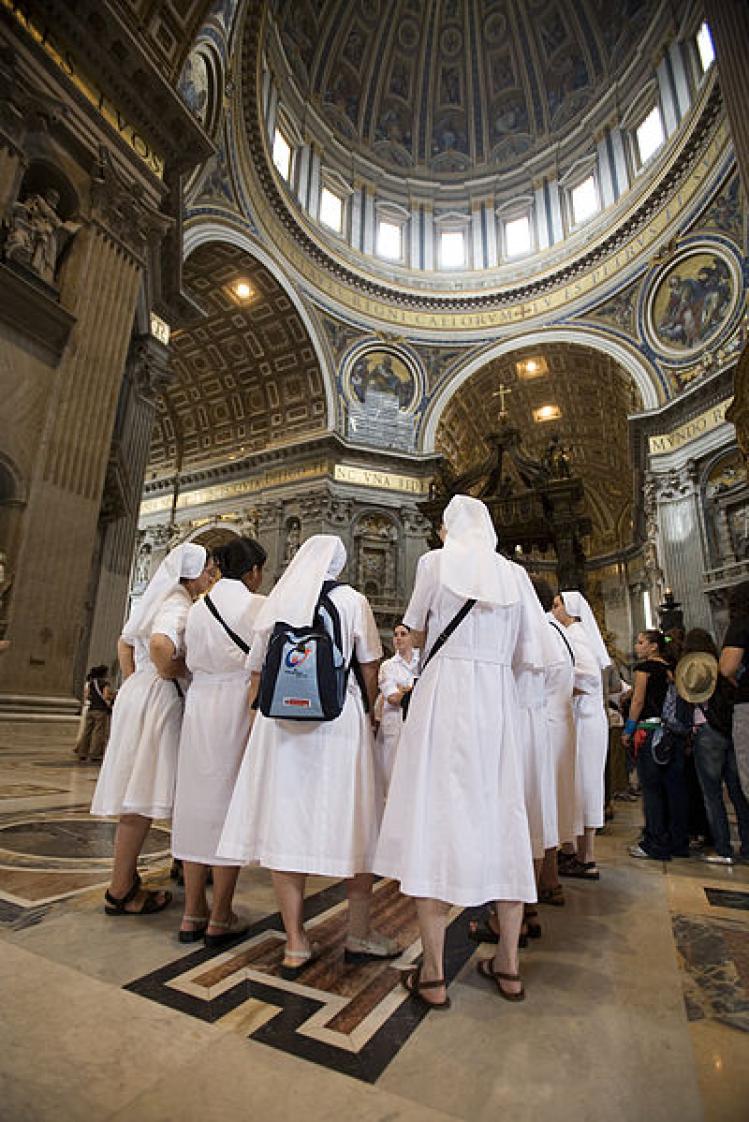
The Congregation for the Doctrine of the Faith’s recent censure of the Leadership Conference of Women Religious for “serious doctrinal problems” raises a number of familiar, if troubling, questions. The LCWR, which represents most American nuns, exists to provide support for the work sisters do for the poor, the imprisoned, the ill, and the marginalized, and to give the various religious communities a corporate voice. As part of the CDF’s action, the LCWR will be put into a kind of receivership under Seattle Archbishop Peter Sartain—essentially suppressing what little autonomy the group has had. Its statutes will be rewritten and speakers for LCWR meetings will now be vetted. The sisters were specifically reprimanded for speaking out in opposition to positions taken by the U.S. bishops but also for keeping “silent” about church teachings on ordination and same-sex marriage. Is silence now considered a form of dissent? Are women religious not even allowed to determine the priorities of their own ministries?
This isn’t about whether everything done under the LCWR aegis is immune from criticism. Feminism has certainly had an influence on the group, and most women religious probably do disagree with the church about women’s ordination. Yes, on occasion New Age spiritualities have gotten a hearing. Yet much of what the LCWR does looks like very smart and sensible women carrying on apostolic activities and preaching more successfully by action than most of the clergy and episcopacy do by word. The LCWR, like the church itself, is a diverse group, and the CDF offers no evidence that the women are unduly influenced by “radical” feminism. It might even be said that the LCWR has faced the same challenge as the bishops and met it better—namely, maintaining community and solidarity, dialogue and conversation, and encouraging innovation, creativity, and risk-taking in service to the gospel.
The CDF action is certain to be a pastoral disaster, another instance of the hierarchy acting in an imprudent and counterproductive fashion. All Catholics should support the effort of the bishops to preserve and pass on the fundamentals of the faith, and correcting doctrinal error is part of that process. But wouldn’t the bishops be more effective in that task if they did not confuse disagreement about public policy with doctrinal dissent—and if the experience and judgment of women were given an honored place and a decisive role in the church’s governance?
Related: Letters, September 14, 2012
Cross Examination, by Sister X
For more coverage on dotCommonweal, click here.


I don't believe that the CDA condemned, as stated here, the LCWR!
Rather, the truth is, that after nearly 40 years of dialogue ( about the same length of time that the Israelites wandered all over the desert) the CDA has exercised both compassion and authority in requesting that those religious orders involved renew their theological formation programs bringing them in line with Church teaching. It is giving them an additional 5 years to complete this request. Of course, some of the more egregious leaders have spoken and said they might consider leaving rather than conform. They are of course free to do this and sad though it always is when members choose to leave the Body of Christ it may perhaps make for a more unified Church and a healthier Church overall. if they follow through with this
God bless you, E.J.Dionne, for voicing my sentiments so well: first, that I cannot abandon the church to the narrow-minded conservative sect whose members would push me out, and second, that many of the church's positions, on abortion, on birth control, on social justice, would be more credible (and no doubt more nuanced) if the voices of women were included in decision processes. The nuns in particular are faith-filled women who have dedicated their lives to the call of the gospel and done so far more credibly than the church hierarchy. The United States bishops would do well to embrace their contributions and begin an honest dialog about how men and women can join forces and work together answering Jesus' call today.
On a more spiritual level, it seems to me that the crux of the matter is that at least some of these Sisters are no longer prepared to follow Jesus in Holy Obedience, and remember they have made vows to that effect. The CDA did acknowlege and praise the great and good works these women (and indeed their predecessors) have done. However their whole 'raison d'etre' is to be dedicated to Christ, and any apostolate should flow from that consecration - the apostolate should never be an end in itself. For at least some of these Sisters the apostolates have either become an end in themselves, or indeed become totally incompatable with orthodox catholic doctrine and teaching e.g. escorting women going in for abortions or actively encouraging homosexual relationships rather than assisting them to lead holy and chaste lives to name but two examples. Some have engaged in neo-paganism or have been actively engaged in other faiths and have therefore ceased to be pracising catholics, whilst other groups have become non-canonical and left the Church whilst claiming to remain catholics. This is what needs to be addressed, and indeed this is what the CDA is trying to do.
Abortion and artificial (as opposed to natural family planning) contraception, are not open to discussion - Church doctrine is very clear on these issues.
As far as ordination for women is concerned - that too has been clearly dealt with.
I would challenge those who think that obedience to the Church disempowers them...obedience and union with the Living God is the most empowering and liberating life changing experience. Did St Therese of Lisieux or St Catherine of Sienna appear disempowered, or Mother Teresa of Calcutta...
maryclare: obedience to Jesus is nit the same as obedience to the men who make up the institutional Church. To think otherwise is idolatrous.
When catholic nuns are reluctant to publicaly proclaim the sanctitiy of human life from conception-then this is more then a disagreement about policies;this goes to the heart of christian theology and ethics[We're made in God's image by God hence life is sacred and good and killing one life for the sake and benefit of another life is a betrayal of that faith.] In not whole heartedly proclaiming the taking of life inside the womb evil and unacceptable-their silence is a matter of docrinal import.When [i read in this forum] a nun invoke the concept intimacy -of mother and gestating fetus-to entertain the possibility that that intimate relationship may allow for the mother to choose to end that intimate relationship-then -christian and human ethics - has been corrupted. That the concept intimacy-which normally suggests love and compassion of one for another-comes to mean the right to murder another-then something is morally rotten in the society of nuns who could think and express such an inversion of human and christian ethics.
The Sisters I know proclaim the sanctity of human life in all they do; where they seem to differ radically from the bishops (who are apparently obsessed with sins that they themselves cannot commit) is their refusal to isolate abortion and contraception from the other, dire "life issues" they confront in their myriad ministries, especially those working directly with very poor women and children. If the bishops had the courage to go into the slums and squalor of the world and spend some time actually relating to some actual, precious "lives," they might not worry so much about what the Sisters are not saying and be challenged and converted by the prophetic power of what the Sisters are DOING. The bishops and pope need to be disabused of one of their most cherished illusions: Christ's Body, the Church, was established to reflect the mind and heart of God, not as a megaphone or platflorm for their own narrow, often thoughtless and shallow views. For a wonderfully refreshing look at a bishop who DOES, indeed, go to the slums and squalor where his people live (and who as a result takes a very different stance from the "magisterial" one on condom-use in AIDS-ravaged South Africa), check out this video: http://www.bc.edu/church21/webcast.html?c21-20040330-dowling-220.mp4#feature-area
By proclaiming the sanctity of life by their good works while remaining silent about the evil of abortion-the Catholic nuns have earned the esteem of the prochoice popular culture.They have chosen in effect to attempt to serve two masters;Christ and the Church and the prochoice popular culture.The vatican is stepping in to tell them-I hope- that the sanctity of life is not limited to abortion but has to include taking a stand against abortion.